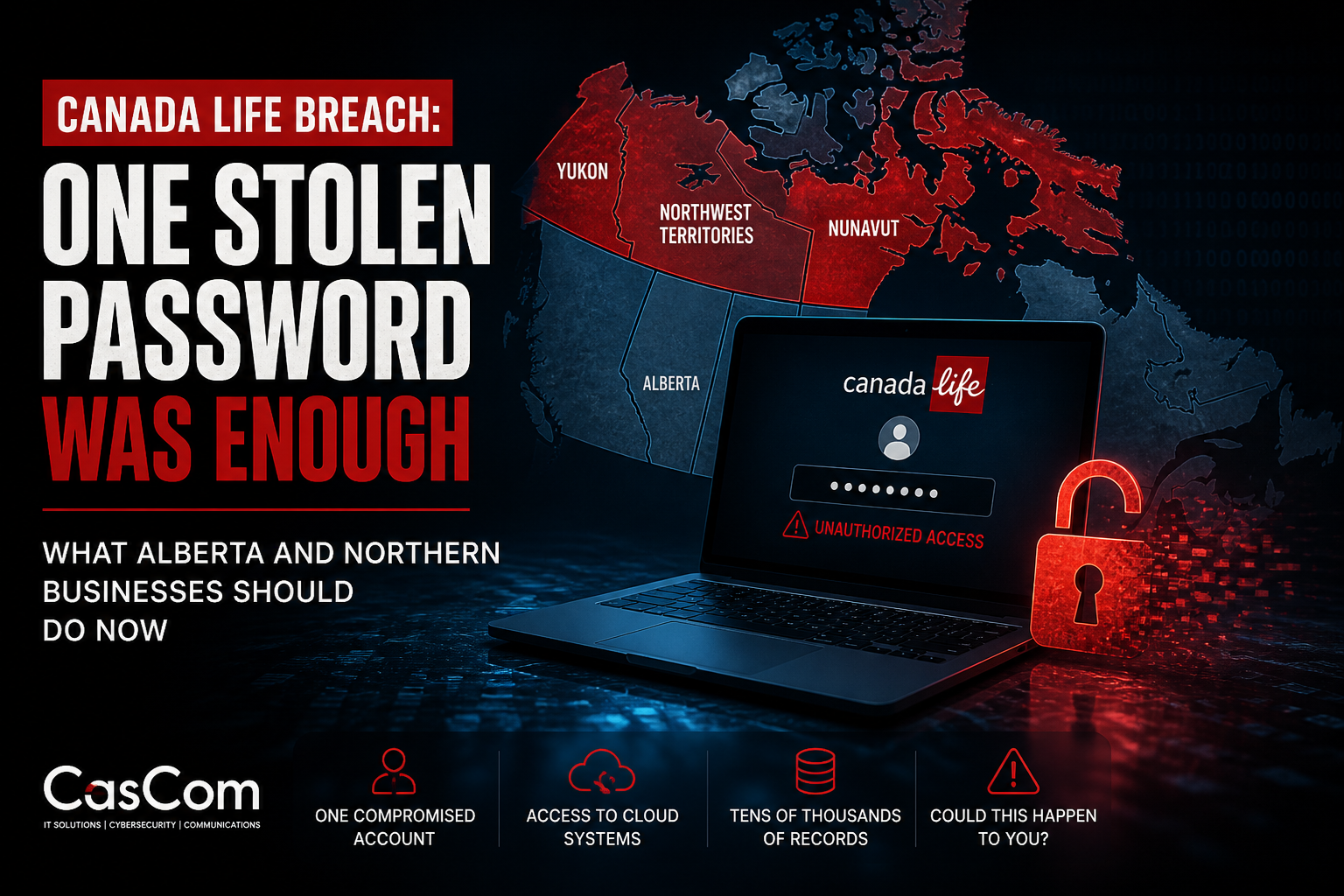
What Alberta, NWT, Yukon, and Nunavut Businesses Should Do Now
One stolen password.
That’s all it took for attackers to reach tens of thousands of records inside Canada Life.
Not a software vulnerability. Not ransomware. Not a sophisticated exploit.
A single employee account.
If your organization runs on Microsoft 365, Salesforce, Google Workspace, or any SaaS platform, you should assume the same attack path exists in your environment.
The question isn’t whether this could happen.
It’s: which account would it happen through?
What Actually Happened
In April 2026, Canada Life disclosed a breach affecting up to 70,000 individuals. Attackers reached the company’s Salesforce environment using a compromised employee account and queried customer data before the company contained the incident.
The threat actor — an extortion group called ShinyHunters — has claimed access to 5.6 million records in the broader environment. Canada Life has not confirmed that figure. The 70,000 number is what’s verified. The 5.6 million number matters because it shows how much one stolen account could potentially reach.
The playbook is one we’ve now seen repeatedly across 2025 and 2026:
- Compromise one employee credential — phishing, reuse, or a help-desk call
- Log in as a legitimate user
- Export large volumes of customer data
- Issue a ransom demand
No system failure. No broken software.
Just valid access used the wrong way.
Why This Hits Alberta and the North Harder
This isn’t just a national headline. It lands closer here, for three reasons.
Group benefits coverage is concentrated. Federal, territorial, and municipal employees across the North; oil and gas workers in Alberta; mining staff in the Slave Geological Province, the Yukon, and the Kivalliq; healthcare workers and Indigenous government employees — many receive coverage through plans administered by Canada Life or its competitors. When one large corporate group makes up the bulk of an affected pool, regional concentration is real.
Workforces are distributed. A mining camp in Nunavut, a fly-in community in the NWT, an exploration team in the Yukon, and a head office in Calgary or Edmonton all log into the same SaaS systems from very different network conditions. Every employee identity becomes a potential entry point — and “impossible travel” detection becomes harder to tune.
SaaS dependence is high. Cloud platforms aren’t optional in the North. They’re how distributed organizations function. The Canada Life incident shows what happens when SaaS access controls don’t keep up with how attackers actually work.
What Was Exposed — And Why It Still Matters
The accessed data included:
- Full name
- Date of birth
- Mailing address
- Gender
- Annual income range
No Social Insurance Numbers. No banking details. No medical information.
That’s genuinely good news.
But it’s still enough for:
- Targeted phishing that references your real address, employer, or birthday
- Identity verification fraud
- Benefits and payroll impersonation
This is exactly the kind of data that makes social engineering work.
The Real Risk Most Businesses Miss
Most organizations picture their cyber risk as malware or hackers breaking in.
In reality, it looks like this:
One employee account logs in. Nothing looks suspicious. Data starts leaving.
If a single account in your business can:
- Export customer or employee data
- Access multiple systems (CRM, email, HR)
- Reset credentials or MFA for other users
…then this attack path already exists in your environment.
You just haven’t seen it used yet.
What Businesses Should Do This Week
If the Canada Life story raised even a small concern internally, act on it now. Five steps, in order of impact.
1. Identify who can export your data.
Run a report on which user accounts can pull large datasets from your CRM, M365, Google Workspace, and HRIS. The list should be short, named, and reviewed quarterly. If you don’t know what the list looks like, assume it’s longer than it should be — especially historical contractor and vendor accounts that were never deprovisioned.
2. Lock down privileged accounts with phishing-resistant MFA.
SMS codes and push notifications are no longer enough. Move privileged accounts to FIDO2 security keys or platform passkeys. For distributed Northern teams, hardware keys are particularly valuable — they remove the dependency on cellular signal that SMS-based MFA carries, which matters if your people work in fly-in communities, mine sites, or anywhere reliable cell service isn’t a given.
3. Turn on anomaly detection.
Salesforce, Microsoft 365, Google Workspace, and most major SaaS platforms can alert you when a user logs in from a new country, downloads an unusually large number of records, or behaves outside their normal pattern. Turn these on. Route them somewhere a human will actually read them. The Canada Life pattern is exactly what bulk-export anomaly detection is designed to catch.
4. Harden your help desk.
Most attackers don’t break in. They call in. ShinyHunters’ standard move is impersonating a locked-out employee and asking for a credential or MFA reset. Help-desk staff need a verified callback or video confirmation before resetting any account with sensitive access. In smaller Alberta and Northern businesses where the “help desk” is one person wearing several hats, this needs to be a documented procedure — not a judgment call in the moment.
5. Rehearse a SaaS breach scenario.
If your compromised system is a SaaS platform you don’t host, your incident response steps are different. You need vendor contacts, log access procedures, and a way to revoke sessions you don’t directly control. Walk through it before you need it. For organizations with remote sites in Nunavut, the NWT, or the Yukon — where connectivity itself becomes a constraint during an incident — this rehearsal matters even more.
If You’re a Canada Life Customer
If you receive group benefits through your employer, assume you may be in scope until you hear otherwise.
- Watch for the official notification from Canada Life. Don’t click links in emails claiming to be the breach notice — go to canadalife.com directly or call the number on a benefits document you already have.
- Enrol in the free credit monitoring being offered.
- Place a fraud alert with Equifax Canada and TransUnion Canada.
- Be sceptical of any “Canada Life” call or email for the next several months. Attackers know who was breached and what data they hold.
- Never share a password, MFA code, or banking detail in response to an inbound call — even if the caller already knows personal details about you.
Identity Is the Perimeter
Attacks like this are increasing for a reason.
It’s easier to log in than break in.
Groups like ShinyHunters and Scattered Spider aren’t exploiting software. They’re exploiting access. The shift is clear:
- Every identity is a potential breach point
- MFA must be phishing-resistant, not just present
- Access must be limited and visible
- Unusual behaviour must be detected early
Canadian privacy regulators expect organizations to take reasonable security measures under PIPEDA. Federal critical-infrastructure obligations are tightening further under Bill C-26. For businesses, governments, and critical operations across Alberta, the Northwest Territories, Yukon, and Nunavut, “reasonable” now clearly includes how you’ve configured the SaaS platforms holding your customers’ and employees’ data.
A More Useful Question Than “Could This Happen to Us?”
If you’re asking “could this happen to us?” — that’s the right instinct.
But here’s the better question:
Which account in our environment could be used the same way?
Most organizations don’t know.
CasCom does this for businesses, governments, and operations across Alberta, NWT, Yukon, and Nunavut — from Edmonton and Calgary through Yellowknife, Hay River, Fort Smith, Whitehorse, Iqaluit, Rankin Inlet, and the remote communities few other providers reach.
We’ll show you exactly where your exposure is:
- Which accounts can access or export sensitive data
- Where identity controls are weak
- What would have to fail for a Canada Life-style breach to happen in your environment
No generic audit. No checklist. Just a clear answer.