For years, technology procurement was reasonably predictable. Computers got faster. Storage and memory got cheaper. If you delayed replacing a workstation for six months, there was a decent chance you would get more computer for the same money.
That assumption is now dangerous.
Consider something as boring as a stick of RAM.
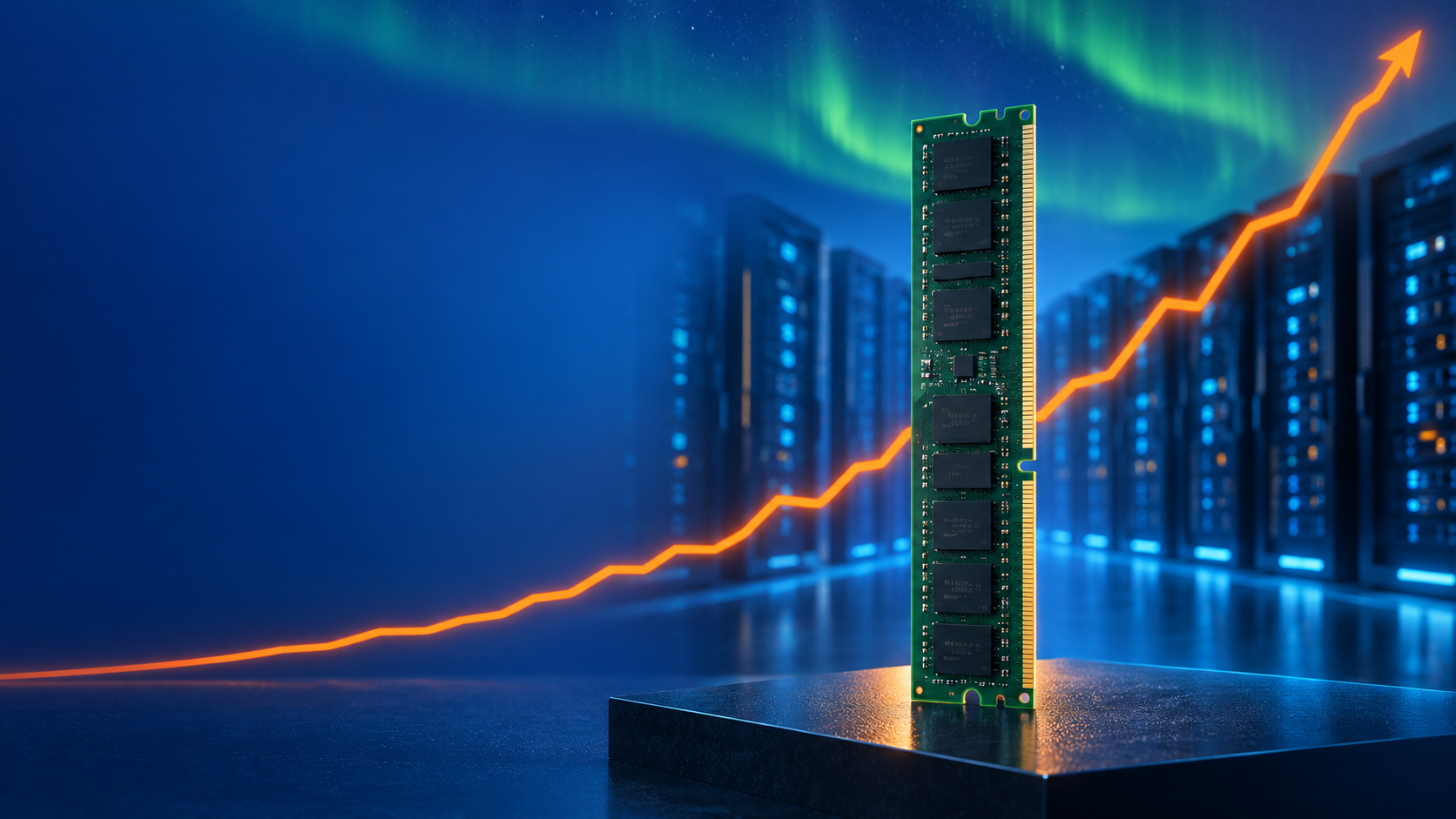
We recently looked at the price history of a standard Crucial 32GB DDR5-5600 desktop memory module. Nothing exotic. No RGB lights, no extreme overclocking, no enterprise server hardware. Just a 32GB DIMM you would install in a normal business workstation.
In June 2025, its tracked average price was US$75.32. By September 2026, the tracked average was approximately US$499.55.
At the Bank of Canada’s September 18, 2026 rate of roughly $1.40 CAD per U.S. dollar, that is the difference between $105 CAD and almost $700 CAD for one stick of RAM.
That is not inflation. That is a market being fundamentally reshaped.
There is a footnote worth knowing. Micron, the company behind Crucial, wound down the consumer brand in early 2026 to concentrate on AI and data-centre customers. The module in our example is scarce partly because its manufacturer decided business desktops were no longer the priority. That is the whole story in one product.
It isn’t just RAM
Memory provides the most dramatic example, but the pressure is spreading across the technology supply chain.
In February, Gartner estimated that combined DRAM and SSD prices will increase 130% by the end of 2026, driving an estimated 17% increase in PC prices compared with 2025. Gartner also expects business buyers to hold devices about 15% longer as higher component costs change the economics of replacement.
TrendForce has documented the same pressure all year. For the second quarter of 2026 alone, it projected conventional DRAM contract prices to rise another 58% to 63% quarter over quarter, with NAND Flash up 70% to 75%.
By the third quarter, increases moderated but did not stop. TrendForce forecast conventional DRAM to rise another 13% to 18%, with NAND Flash up another 10% to 15%. The slowdown is not new supply arriving. It is PC and phone makers reaching the limit of what they can pay.
For anyone purchasing computers, servers, firewalls or storage systems, those numbers matter. A lot.
So what happened?
The short version is AI. The longer answer is more interesting.
The global buildout of AI infrastructure has created extraordinary demand for memory, storage, GPUs, networking and data-centre hardware. The companies manufacturing these components do not have unlimited production capacity.
When hyperscale cloud providers and AI companies order enormous quantities of high-performance memory, manufacturers move capacity toward those products. TrendForce reports that suppliers are prioritizing high-capacity server memory while inventories remain extremely low. That leaves less capacity for ordinary PCs.
In other words, the computer on your employee’s desk now competes for the same semiconductor manufacturing capacity that feeds AI data centres.
Microsoft, Amazon, Google and Meta sign multi-year supply agreements for staggering quantities of infrastructure. Your next laptop order does not.
Guess which customer has more influence on the supply chain?
Canada gets another layer of volatility
Canadian organizations have another variable to contend with: currency.
Most technology components are manufactured, distributed and priced internationally, and most of that supply chain is denominated in U.S. dollars. With one U.S. dollar costing approximately $1.40 Canadian, Canadian businesses get hit twice. A manufacturer raises the underlying cost of a component, and the exchange rate amplifies that increase before the product ever reaches a Canadian invoice.
Add distribution, inventory availability and changing vendor programs, and the price of exactly the same piece of technology will look very different from one month to the next.
The North adds a third
For organizations in Yellowknife, Inuvik, Whitehorse, Iqaluit and the communities between them, there is one more layer.
Hardware reaches the North by truck, barge, winter road or air freight, and lead times were long before memory got scarce. When a distributor’s stock disappears in the south, there is no local shelf to fall back on. A model that is available in Edmonton on Monday can be gone before a Northern purchase order clears.
Mine sites, territorial and Indigenous governments, and remote camps also tend to buy on fixed fiscal cycles with formal approval steps. A quote that expires in 30 days and an approval process that takes 90 no longer fit together.
The old budgeting model doesn’t work anymore
This is a problem for any organization that still budgets technology like office furniture.
A department identifies what it needs. Someone gets a quote. The project goes into next quarter’s budget. Approval takes two months. Procurement waits another month. Then everyone expects the original price to still exist.
Increasingly, it doesn’t.
A quote created today represents inventory that exists today, at a distributor price negotiated today, at today’s exchange rate. Thirty, sixty or ninety days later, any one of those variables will have moved.
This doesn’t mean businesses should panic-buy technology. It means procurement needs to become more deliberate:
- Plan the lifecycle of computers, servers, storage and networking equipment instead of waiting for hardware to fail.
- Budget with contingency for component volatility.
- Shorten approval cycles so you can act when favourable pricing or inventory appears.
- Standardize equipment so alternatives can be sourced quickly when a particular model disappears.
- Check quote validity. A six-month-old hardware quote is no longer meaningful.
- Compare total lifecycle cost rather than automatically buying the least expensive configuration available today.
The days of assuming technology will be cheaper next year are behind us for the foreseeable future.
Cheap today becomes expensive tomorrow
Underspecifying computers to save a few hundred dollars becomes an expensive decision when upgrades cost several times what they used to.
Imagine choosing 16GB of RAM instead of 32GB across a workstation fleet because it saved $100 per machine. Historically, that was a small risk. RAM could be added later.
Our own example shows memory costing more than six times what it did 15 months ago. At those prices, the upgrade you deferred costs more than the saving ever did. And that assumes the modules are still available, and that the manufacturer has not changed platforms before your next refresh.
The same principle applies to storage, servers, network infrastructure, backup capacity and, increasingly, GPUs and AI-capable computers.
Spending slightly more on the right specification today is often cheaper than retrofitting it tomorrow.
Why technology needs a lifecycle strategy
Good IT planning answers more than “What computer should we buy?” It answers:
- What are we running, and how old is it?
- When should it be replaced?
- What will the organization need three years from now?
- What equipment is approaching end of support?
- Where could a supply shortage create operational risk?
- What should we buy now instead of waiting until failure forces the decision?
That is the difference between purchasing technology and managing technology.
At CasCom, we spend a lot of time helping partners across the Northwest Territories, Nunavut, Yukon and Alberta build technology roadmaps. Infrastructure decisions should not begin when a server dies, a laptop fleet reaches end of life, or someone discovers that the equipment quoted six months ago now costs 40% more.
A good technology roadmap gives an organization time. Time to budget, to compare options, to standardize and to procure strategically.
And in today’s market, time to decide when not to wait.
The takeaway
Technology pricing has always fluctuated. What is different today is the size and speed of the changes.
AI infrastructure investment, manufacturing capacity constraints, currency movement and Northern logistics have created a market where yesterday’s assumptions cannot be carried into tomorrow’s budget.
A basic 32GB stick of memory going from roughly $100 to nearly $700 Canadian is an extreme example. It also makes the point.
The question is no longer “How much does a computer cost?” The better question is:
“What does it cost today, how exposed are we if that changes, and when is the right time to buy?”
That is a conversation worth having before the next refresh cycle lands on your desk.
2027 IT Budget Planning
Know what you are running, and when to buy.
CasCom will assess your existing environment, map upcoming lifecycle requirements, and build a technology roadmap that accounts for both your operations and a much more volatile hardware market.
Book a technology roadmap review