You Trust Your Vendors. But Have You Checked Their Cybersecurity?
You hired a new accounting firm. Or a bookkeeper. Or a payroll provider. Or an HR consultant.
You know them. Their office is down the street. You have worked with them before. They know your team. They answer the phone. They seem organized. They came recommended by someone you trust.
So you give them access.
Access to payables. Payroll records. Client files. Cloud folders. Invoices. Banking details. Employee data. Email threads. Shared drives. Portals. Maybe even remote access into your systems.
That feels normal.
But here is the question most organizations never ask:
Who is securing them?
Not who owns the company. Not how long they have been in business. Not whether they are friendly, professional, or local.
Who manages their computers?
Who watches their email security?
Who backs up their data?
Who handles their passwords?
Who patches their systems?
Who responds if they get breached?
Who makes sure your information is not sitting inside a weak digital environment?
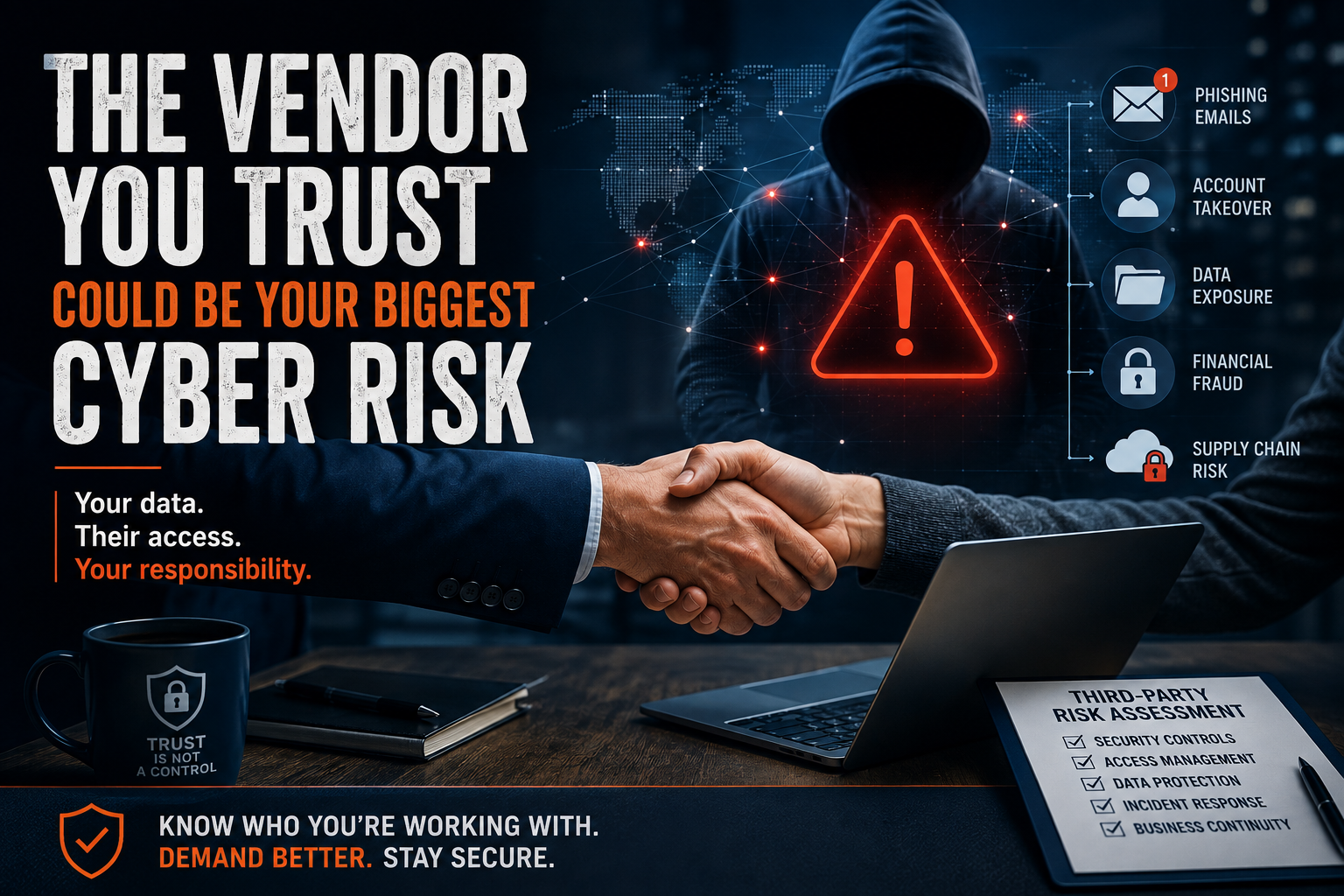
Because once a vendor has access to your business, their cybersecurity becomes part of your cybersecurity.
Trust is not a security control
This is where many businesses get uncomfortable.
You trust your bookkeeper. You trust your accountant. You trust your lawyer. You trust your construction partner, payroll provider, consultant, supplier, or service company.
Good. You should work with people you trust.
But trust does not stop phishing emails. Trust does not patch laptops. Trust does not enforce multi-factor authentication. Trust does not detect a compromised mailbox before invoices get redirected. Trust does not recover files after ransomware lands inside a vendor’s network.
A vendor can be honest, competent, and reliable, while still being a serious cybersecurity risk.
That is the gap.
Most vendor relationships are evaluated on price, reputation, speed, and personal history. Cybersecurity often gets skipped because the relationship feels safe.
That is exactly why it becomes dangerous.
The breach does not need to start inside your company
A lot of leaders picture a cyberattack as someone breaking directly into their network.
That is one path.
But there is another path that is easier and often quieter.
An attacker compromises one of your vendors. They get into that vendor’s email. They study invoices, payment patterns, names, timing, language, and approval chains. Then they send a message that looks normal because it comes from a real account, in a real thread, about real work.
No alarms go off. Nobody panics. The request feels familiar.
“Please update our banking details.”
“Can you review this attached invoice?”
“Here is the revised payment schedule.”
“Please upload the documents here.”
That is how third-party risk turns into your risk.
The vendor was the door. Your organization was the target.
Your vendors hold more than you think
Most organizations underestimate how much access vendors actually have.
Your accounting firm could have payables, banking information, tax records, financial statements, and signing authority workflows.
Your bookkeeper could have vendor lists, cheque runs, employee details, cloud folders, and invoice history.
Your legal team could have contracts, disputes, acquisition files, confidential correspondence, and identity documents.
Your HR consultant could have employee records, salary details, benefit information, disciplinary files, and onboarding documents.
Your construction partners could have site plans, project schedules, access lists, bid data, and safety documentation.
Your IT, telecom, software, or cloud vendors could have administrative access that reaches deep into your business.
That does not mean these vendors are doing anything wrong.
It means they are carrying risk on your behalf.
So the real question is simple:
Are they carrying it properly?
“They are small” is not an excuse
Small vendors often get a pass.
“They are just a local bookkeeper.”
“It is only a two-person firm.”
“They are not a big company.”
“We have known them for years.”
That thinking is backwards.
Smaller vendors often have the same sensitive access as larger firms, but less mature protection. One person handles accounting, admin, client service, passwords, backups, and technology decisions. Their “IT guy” could be a friend, a break-fix shop, a family member, or nobody at all.
That is not a criticism. It is a reality.
Small teams are busy. They focus on serving clients. Cybersecurity becomes a thing they plan to fix later.
But your data is not waiting for later.
Third-party risk is now basic business hygiene
You do not need to treat every vendor like a suspect.
You do need to treat vendor access like a real business risk.
A third-party cybersecurity assessment is not about shaming partners or making relationships difficult. It is about knowing what you are connected to.
It answers practical questions:
Do they use multi-factor authentication?
Are devices patched and protected?
Are passwords managed properly?
Is email protected against phishing and account takeover?
Are backups in place and tested?
Who provides their IT support?
Do they have a response plan if something goes wrong?
Do they limit access to only what they need?
Do they have basic security policies their team actually follows?
Can they prove they are taking reasonable steps to protect the information you share?
These are not extreme questions.
They are the questions responsible organizations should already be asking.
The uncomfortable truth
If one of your key vendors gets compromised and your data is exposed, your clients will not care that it happened “outside” your company.
They will ask why their information was there.
They will ask who had access.
They will ask what security requirements you had in place.
They will ask why nobody checked.
That is the part leaders need to take seriously.
Cybersecurity is no longer contained inside your own four walls. Your business now runs through shared platforms, outside advisors, cloud tools, remote teams, contractors, service providers, and connected vendors.
Your risk travels with your data.
If your data leaves your environment, your responsibility follows it.
What CasCom is offering
CasCom is offering third-party cybersecurity assessments for key critical vendors connected to our clients and partners.
This is built for organizations that depend on outside firms for important work and want a clear view of the risk before something goes wrong.
We will help you identify which vendors matter most, assess their cybersecurity posture, document the findings, and give you a practical path forward.
Not every vendor needs the same level of review. Your coffee supplier does not need the same scrutiny as your bookkeeper, payroll provider, legal firm, cloud software vendor, or remote access contractor.
The priority is simple:
Start with vendors who have access to money, systems, sensitive data, operations, or client information.
Those are the relationships that deserve a closer look.
This is not about making vendors jump through hoops
The goal is not to bury good partners in paperwork.
The goal is to raise the floor.
A strong vendor assessment gives both sides clarity. Your organization knows where the risk sits. Your vendor understands what needs to improve. Everyone gets a better path to protect the relationship.
The best vendors will welcome this.
They already know cybersecurity matters. They already understand that trust needs proof. They will see the assessment as a sign that you take the relationship seriously.
The weak ones will avoid the conversation.
That tells you something too.
What you should ask this week
Pick five vendors who have meaningful access to your business.
Then ask these questions:
Who manages your IT and cybersecurity?
Do you require multi-factor authentication on email and business systems?
How are your devices protected and updated?
How are client files stored and backed up?
What happens if your email account is compromised?
Who do we call if there is a suspected incident involving our data?
Can you provide evidence of your basic cybersecurity controls?
You do not need a perfect answer from every vendor.
You do need a real answer.
Silence, confusion, or “we have never thought about that” is a signal.
The new standard
Vendor due diligence cannot stop at price, insurance, and references.
Not anymore.
If a vendor touches your money, your data, your systems, your people, or your operations, their digital environment matters.
You would not hand office keys to someone without knowing who they are.
So do not hand over digital access without knowing how they protect it.
Your vendors are part of your business ecosystem.
Make sure they are not the weakest link in it.
CasCom is helping our partners and clients assess the cybersecurity posture of their key vendors.
Start with the vendors who hold the most risk: accounting, bookkeeping, payroll, legal, HR, cloud platforms, IT-connected providers, and anyone with access to sensitive operational or client data.
Know who you are working with.
Know how they are secured.
Demand appropriate cybersecurity standards from the people who carry your data.
And when you do not have the time, team, or tools to assess it yourself, bring CasCom in.
We will help you find the gaps before an attacker does.