
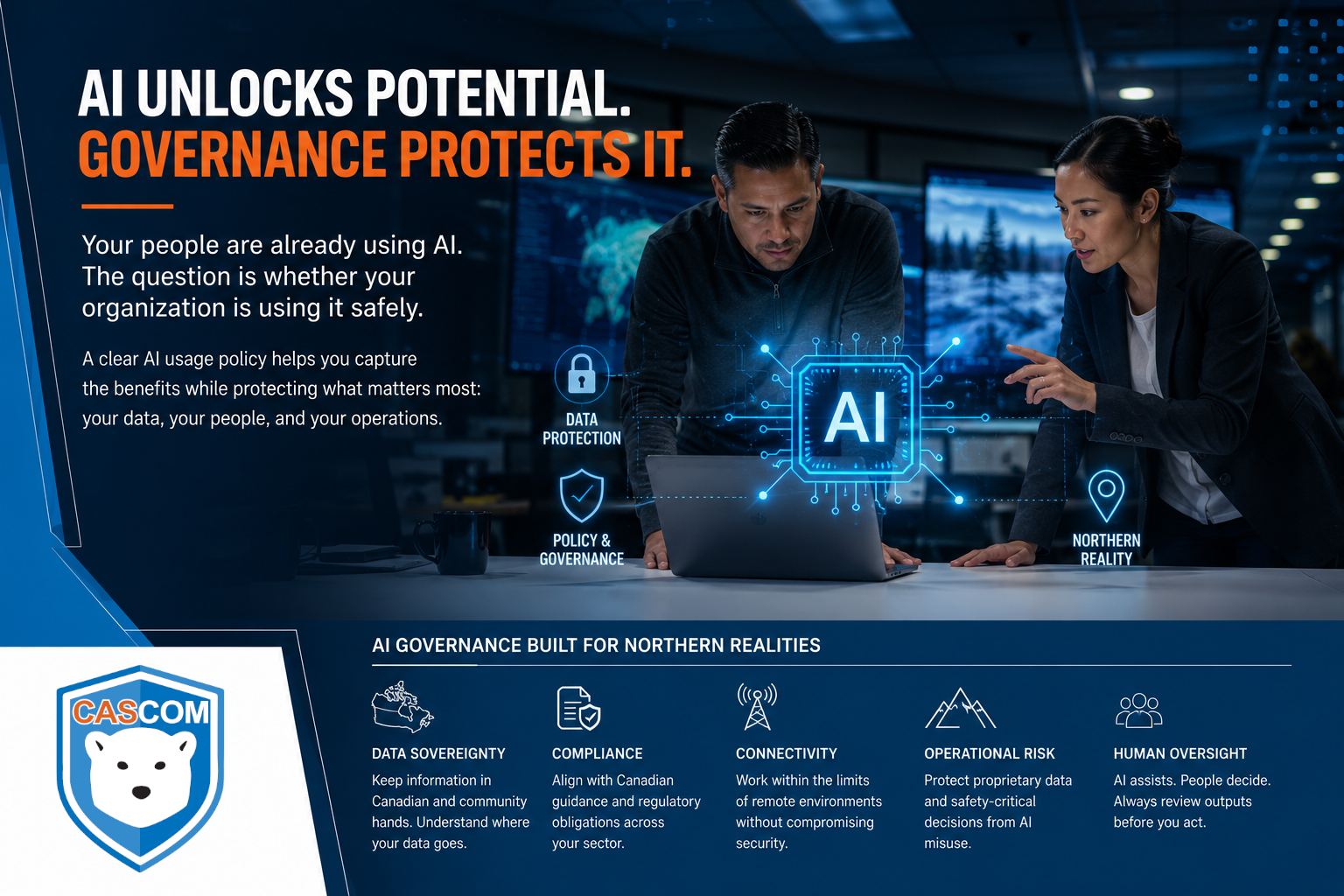
If you lead an organization today, there is a good chance employees are already using AI tools.
Not next year. Not after the next budget cycle. Right now.
Some are using ChatGPT to draft emails. Others are summarizing reports, writing spreadsheet formulas, or preparing meeting notes. In many organizations, this is happening with management’s knowledge. In many others, it is happening without it.
That is the reality of AI adoption.
The question is no longer whether AI is present in your organization. The question is whether anyone is governing its use.
Shadow AI Is Already Here
Shadow AI is the use of unapproved AI tools by employees outside official policies, processes, or IT oversight.
In practice, it often looks harmless.
An employee copies text from a document into a public AI chatbot to improve the wording. A manager asks an AI assistant to summarize a report. A staff member uploads a spreadsheet to generate insights more quickly.
The problem is not the intent. The problem is control.
When information is entered into public AI services, organizations often lose visibility into where that information goes, how it is processed, and what protections apply to it.
Most employees are trying to solve problems and save time. They are not trying to create risk.
Without governance, however, risk becomes the byproduct of productivity.
Why Banning AI Creates More Risk
The first reaction many organizations have is simple.
Ban it.
Unfortunately, that approach rarely works.
When people see AI helping them complete work faster, they continue looking for ways to use it. If approved tools are unavailable, they turn to personal devices and personal accounts.
At that point, the organization loses whatever visibility and oversight it had.
Prohibition creates the shadow.
Governance brings activity back into the open, where expectations are clear and controls can be applied.
Organizations that succeed with AI do not try to pretend it does not exist. They create guardrails that allow staff to use it responsibly.
Why the Stakes Are Higher in Northern Canada
Much of the advice written about AI governance assumes a large urban office environment with abundant connectivity, centralized resources, and relatively straightforward compliance requirements.
Many organizations across Northern Canada operate under very different conditions.
A territorial department, Indigenous government, financial institution, remote mine site, or regional development corporation faces risks and responsibilities that generic AI guidance often overlooks.
For these organizations, governance is not simply an IT issue.
It is an operational issue, a compliance issue, and increasingly a leadership issue.
Data Residency and Sovereignty Matter
Many public AI services process information outside Canada.
Depending on the platform and configuration, data can be stored, transferred, or processed in foreign jurisdictions.
For government organizations and regulated industries, that creates immediate concerns around data residency, privacy obligations, and control over information assets.
A document pasted into a public AI service can leave the environment where it was intended to remain.
That reality alone should drive policy decisions.
Before any organization adopts AI tools, leaders should understand where information goes, who controls it, and what contractual protections exist around its use.
Indigenous Data Sovereignty Requires Special Care
For Indigenous governments and development corporations, the conversation goes beyond standard privacy and compliance requirements.
Community information carries rights, responsibilities, and cultural significance.
The principles of Ownership, Control, Access, and Possession, commonly known as OCAP, establish important expectations around how First Nations data is governed and protected.
Uploading community information into public AI platforms can conflict with those principles if organizations lose control over where information is stored, processed, or accessed.
This is not a technical checkbox.
It is a governance responsibility.
Organizations must ensure that AI adoption respects existing data governance frameworks and community expectations from the beginning.
Government Organizations Face Additional Obligations
Public sector organizations handle sensitive information every day.
Protected records, citizen information, internal deliberations, and operational documents all carry obligations around collection, storage, disclosure, and retention.
Federal organizations must consider guidance related to responsible use of generative AI alongside existing privacy and information management requirements.
Territorial departments must also account for applicable access to information and privacy legislation.
An employee copying sensitive content into a public AI platform can create compliance concerns long before anyone realizes it happened.
A written policy helps staff understand where the boundaries are before mistakes occur.
Mining and Resource Operations Have Different Risks
In resource industries, information itself is often a strategic asset.
Geological data, exploration results, engineering plans, environmental studies, operational forecasts, and commercial agreements can carry substantial competitive value.
AI tools can help teams work more efficiently with these materials.
They can also expose them if appropriate controls are absent.
There is another concern.
Generative AI systems are designed to produce plausible answers. Plausible is not the same as correct.
In safety-critical environments, a confident but incorrect recommendation can create operational consequences that extend well beyond a productivity issue.
Human review remains essential.
Financial Institutions Must Protect Trust
Financial organizations already understand the importance of safeguarding sensitive information.
Client records, financial data, internal analyses, and confidential communications require strong controls.
Introducing AI without clear governance increases exposure to privacy, confidentiality, and regulatory risks.
The objective is not to avoid AI.
The objective is to use AI in ways that preserve client trust and maintain accountability.
Connectivity Changes the Risk Picture
Northern operating conditions create challenges that many governance discussions ignore.
Remote facilities often depend on satellite connectivity, Starlink, or other constrained communications infrastructure.
When staff need a tool that works immediately, they will often use whatever cloud service is available.
That reality increases the likelihood of unsanctioned AI adoption.
Without a clear policy and approved alternatives, organizations can end up with multiple AI tools being used across sites, departments, and personal devices, each with different privacy protections and risk profiles.
The North’s operating environment makes governance harder.
It also makes governance more important.
The Guidance Already Exists
Organizations do not need to start from scratch.
The Canadian Centre for Cyber Security has published guidance on the secure use of generative AI. The federal government has also established direction around responsible use of generative AI within public sector environments.
For organizations participating in defence-related supply chains, the Canadian Program for Cyber Security Certification (CPCSC) reinforces the broader importance of managing information assets, security controls, and third-party risk.
None of these frameworks suggest avoiding AI altogether.
They point toward responsible governance, risk management, and informed adoption.
That is where the conversation should focus.
What a Practical AI Usage Policy Looks Like
A useful AI policy should be straightforward enough that employees will actually follow it.
At minimum, it should answer several key questions:
Which AI tools are approved?
Employees need clarity on which services can be used for business purposes and under what circumstances.
What information is prohibited?
The policy should clearly identify categories of information that must never be entered into public AI systems, including confidential, protected, client, community, operational, and proprietary data.
Who remains accountable?
AI can assist with work. It cannot own decisions. Employees remain responsible for the accuracy and appropriateness of outputs.
What level of review is required?
Every AI-generated output should be reviewed by a qualified person before it is acted upon, distributed, or relied upon.
What training is expected?
Staff need practical guidance on appropriate use, risks, and organizational expectations.
How will compliance be monitored?
Technical controls, auditing, and oversight help ensure policy becomes practice.
Governance Beats Prohibition
The organizations seeing the greatest value from AI are not the ones trying to stop its use.
They are the ones creating safe paths for adoption.
Enterprise-grade AI platforms increasingly offer commercial data protections, stronger administrative controls, and commitments not to train models on customer data. Properly configured, these solutions deliver much of the productivity benefit while significantly reducing exposure.
The goal is not unrestricted access.
The goal is controlled access.
That distinction matters.
Where to Start
Start with visibility.
Find out what tools employees are already using.
Then establish a practical AI usage policy that reflects your operational realities, compliance obligations, and risk tolerance.
From there, implement the technical controls, approved platforms, and staff training required to support responsible adoption.
This is not a one-time technology purchase.
It is an ongoing governance process.
For nearly three decades, CasCom has helped organizations across Northern Canada balance innovation, security, and operational resilience. The same approach applies to AI. Success comes from understanding the technology, understanding the risks, and building a framework that works in the real world.
If your organization is beginning to explore AI, or if you suspect AI is already being used without clear oversight, a conversation is a practical place to start. The objective is not to slow innovation. It is to ensure innovation happens on your terms.